Showing posts with label A. Show all posts

Azalea


Azalea flowers are a type of flowering plant of family Ericaceae that grow in temperate climates. These plants grow in areas of Southeast Asia, Australia and America. This flower is used as ornamental plants. They grow in forests and swamps. This flower is also used as barrier fences.


This flower has various colors; like red, white, purple and yellow. But there are over 10,000 species now. Looking at these plants makes the heart feel cool and happy. Azelea serves as carbon dioxide absorber and gives a cool aura. Azalea flowers can be propagated by cuttings or by seed.


Azaleas do not require much sunlight. The leaves will turn yellow and the flowers will be small if it receives too much sun. This plant is also easily propagated. The easiest way to do is by stem cuttings. This flower is legendary. Many contemporary stories in china mention them in ancient stories. 


Azaleas are flowering shrubs comprising two of the eight subgenera of the genus Rhododendron, Pentanthera (deciduous) and Tsutsuji (evergreen). Azaleas bloom in spring, their flowers often lasting several weeks. Shade tolerant, they prefer living near or under trees.


Plant enthusiasts have selectively bred azaleas for hundreds of years. This human selection has produced over 10,000 different cultivars which are propagated by cuttings. Azalea seeds can also be collected and germinated.


Azaleas are generally slow-growing and do best in well-drained acidic soil (4.5–6.0 pH). Fertilizer needs are low; some species need regular pruning. Azaleas are native to several continents including Asia, Europe and North America. They are planted abundantly as ornamentals in the southeastern US.


Azalea leafy gall can be particularly destructive to azalea leaves during the early spring. Hand picking infected leaves is the recommended method of control.They can also be subject to phytophthora root rot in moist, hot conditions.


In Chinese culture, the azalea is known as "thinking of home bush" (siangish shu) and is immortalized in the poetry of Tu Fu and is used to rich effect in contemporary stories such as by Taiwanese author Pai, Hsien-Yung. The azalea is also one of the symbols of the city of São Paulo, in Brazil. 


In addition to being renowned for its beauty, the Azalea is also highly toxic--it contains andromedotoxins in both its leaves and nectar, including honey from the nectar. The Azalea and Rhododendron were once so infamous for their toxicity that to receive a bouquet of their flowers in a black vase was a well-known death threat.


Many cities in the United States have festivals in the spring celebrating the blooms of the azalea, including Norfolk, Virginia; Wilmington, North Carolina (North Carolina Azalea Festival); Valdosta, Georgia; Palatka, Florida (Florida Azalea Festival); Pickens, South Carolina;. 


The Azalea Trail is a designated path, planted with azaleas in private gardens, through Mobile, Alabama. The Azalea Trail Run is an annual road running event held there in late March. Mobile, Alabama is also home to the Azalea Trail Maids, fifty women chosen to serve as ambassadors of the city while wearing antebellum dresses, which originally participated in a three-day festival, but now operate throughout the year.


Motoyama, Kochi also has a flower festival in which the blooming of Tsutsuji is celebrated and Tatebayashi, Gunma is famous for its Azalea Hill Park, Tsutsuji-ga-oka. Nezu Shrine in Bunkyo, Tokyo, holds a Tsutsuji Matsuri from early April until early May.


Posted in | Leave a comment

Amaryllis


Amaryllis flowers are a type of lily. The name Amaryllis is taken from a shepherdess in Virgil's pastoral "Eclogues", from the Greek ἀμαρύσσω (Latin amarysso) meaning "to sparkle." 


For many years there was confusion amongst botanists over the generic names Amaryllis and Hippeastrum, one result of which is that the common name "amaryllis" is mainly used for cultivars of the genus Hippeastrum, widely sold in the winter months for their ability to bloom indoors. Plants of the genus Amaryllis belladonna are known as belladonna lily, naked lady, Amarillo or, in South Africa, March lily. 


Amaryllis flower is so beautiful and attractive with a beautiful crown.  Amaryllis flowers even more beautiful than the lily. Usually these plants bloom in groups of three or more. These lily-like flowers grow eight to ten inches wide. 


The flowers are located on the stalk. Highest Amaryllis can reach two human feet. While the leaves are long like the band grew directly from the bulbs.


Amaryllis flowers have a variety of colors, among others; there are red, white, pink, salmon, and orange. There are also striped and colored mixtures.  


Each inflorescence consists of 2-6 flowers that bloom simultaneously. Amaryllis itself is shaped like a trumpet-lipped six.


The plant of the Amaryllis is bulbous, with each bulb being 5–10 cm in diameter. It has several strap-shaped, green leaves, 30–50 cm long and 2–3 cm broad, arranged in two rows. 


The leaves are produced in the autumn or early spring in warm climates depending on the onset of rain and eventually die down by late spring. 


The bulb is then dormant until late summer. The plant is not frost-tolerant, nor does it do well in tropical environments since they require a dry resting period between leaf growth and flower spike production.


From the dry ground in late summer (August in zone 7) each bulb produces one or two leafless stems 30–60 cm tall, each of which bears a cluster of 2 to 12 funnel-shaped flowers at their tops. Each flower is 6–10 cm diameter with six tepals (three outer sepals, three inner petals, with similar appearance to each other). 


The usual color is white with crimson veins, but pink or purple also occur naturally. The common name "naked lady" stems from the plant's pattern of flowering when the foliage has died down.


Posted in | Leave a comment

Allium


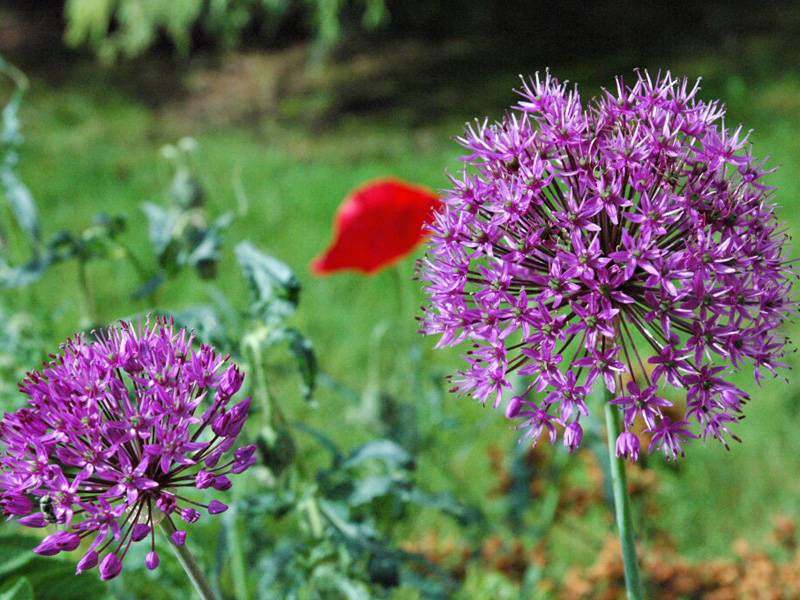
Allium is the flower in the hands of a wedding reception. They could become the focus of interest. This interest also can be used as cut flower and decoration flower. 


Alliums are also popularly known as garlic. These are very beautiful flowers and very attractive. There are several types of allium.  Among them Allium sativum is famous. All the flowers of the allium family (leeks, chives, garlic, garlic (garlic chives)) are edible and have a taste. 


The flavor is contained from the leeks and is soft until the garlic is sturdy. All parts of this plant are edible.  Allium is a monocot genus of flowering plants, informally referred to as the onion genus. The generic name Allium is the Latin word for garlic. 


The genus contains hundreds of distinct species; many have been harvested through human history, but only about a dozen are still economically important today as crops or garden vegetables. Many others are cultivated as ornamental plants.


Allium is taxonomically difficult and species boundaries are unclear. Most authorities accept about 750 species.  Estimates of the number of species have been as low as 260, and as high as 860. The type species for the genus is Allium sativum.


Allium species occur in temperate climates of the northern hemisphere, except for a few species occurring in Chile (such as A. juncifolium), Brazil (A. sellovianum) or tropical Africa (A. spathaceum). They can vary in height between 5 cm and 150 cm.


The flowers form an umbel at the top of a leafless stalk. The bulbs vary in size between species, from very small (around 2–3 mm in diameter) to rather large (8–10 cm). Some species (such as Welsh onion, A. fistulosum) develop thickened leaf-bases rather than forming bulbs as such.


Allium is a genus of perennial bulbous plants that produce chemical compounds (mostly cysteine sulfoxide) that give them a characteristic onion or garlic taste and odor.


Many are used as food plants, though not all members of the genus are equally flavorful. In most cases, both bulb and leaves are edible. Their taste may be strong or weaker, depending on the species.


Allium is one of about 57 genera of flowering plants that have more than 500 species. It is by far the largest genus in the Amaryllidaceae, and also in the Alliaceae in classification systems in which that family is recognized as separate.


Allium species are herbaceous perennials with flowers produced on scapes. They grow from solitary or clustered tunicate bulbs and many have an onion odor and taste. Plants are perennialized by bulbs that reform annually from the base of the old bulb, or are produced on the ends of rhizomes or, in a few species, at the ends of stolons.


A small number of species have tuberous roots. The bulbs have outer coats that are commonly brown or grey, with a smooth texture, and are fibrous, or with cellular reticulation. The inner coats of the bulbs are membranous.


Many alliums have basal leaves that commonly wither away from the tips downward before or while the plant flower, but some species have persistent foliage. Plants produce from one to twelve leaves, most species having linear, channeled or flat leaf blades.


The leaf blades are straight or variously coiled, but some species have broad leaves, including A. victorialis and A. tricoccum. The leaves are sessile, and very rarely narrowed into a petiole.


The terete or flattened flowering scapes are normally persistent. The inflorescences are umbels, in which the outside flowers bloom first and flowering progresses to the inside. Some species produce bulbils within the umbels, and in some species the bulbils replace some or all the flowers. The umbels are subtended by noticeable spathe bracts, which are commonly fused and normally have around 3 veins.


The flowers are erect or in some species pendent, having six petal-like tepals produced in two whorls. The flowers have one style and six epipetalous stamens; the anthers and pollen can vary in color depending on the species. The ovaries are superior, and three-lobed with three locules.


The fruits are capsules that open longitudinally along the capsule wall between the partitions of the locule. The seeds are black, and have a rounded shape.


The majority of Allium species are native to the Northern Hemisphere, mainly in Asia. A few species are native to Africa and Central and South America. Species grow in various conditions from dry, well-drained mineral-based soils to moist, organic soils; most grow in sunny locations but a number also grow in forests, or even in swamps / water.


Posted in | Leave a comment

Allamanda


Allamanda comes with a sweet and beautiful yellowish look. They are also known as Yellow Bell, Golden Trumpet or Buttercup Flower. Allamanda was named after Dr. Frédéric-Louis Allamand (1735-1803) who was a Swiss botanist of the late 18th century.


Most of the time, they are yellow. But they can be of various colors, like: yellow, white, brown, purple etc. Usually Allamanda has bright color. Allamanda has a very nice shape like a trumpet. They bloom all the year. The stem of Allamanda is hard and gummy.


Allamanda plants usually have a height of 3-8 meters. So they are widely planted to beautify the walls. Alamanda is native to South and Central America. They bloom year round. Their bright yellow color with trumpet shape made them perfect for ornamentals. 


The leaves of Allamanda are lancelike and pointed. The flowers are 5-7.5 centimetres in diameter. Allamanda has a delicate and fruity scent. 


Allamanda usually grows in the wild. Most of the time, they are found along riverbanks and other open, sunny areas where adequate rainfall and moist soil is available. Allamanda cannot grow under shades. 


Allamanda sap has antibacterial and possibly anticancer properties. The beautiful yellow Allamanda soothes heart. 


Posted in | Leave a comment